Outdoor health & impact finance


Exploring pathways to finance the positve outcomes of outdoor time

year:
2024

Built an understanding of current challenges, strengths and future visions that informed the starting point of the innovation project.

Duration
2 weeks
01
partner
my role
facilitation and systemic design

the brief

Project process

Friluftsfrämjandet

The spillover of positive externalities, or benefits resulting from outdoor lifestyle activities, is often unaccounted value within financing models.

Together with several stakeholders within Friluftsfrämjandet, we explored the overlap between outdoor lifestyle and public health. The project worked to identify opportunity areas in which this spillover could create a co-beneficiary relationship between the two. Friluftsfrämjandet maintains a rich set of activity data that has the potential to serve as the metrics required for a proof-of-impact impact financing ecosystem.

The scope was limited to identifying a foundation that could establish the grounds for a deeper dive into the context and relationships.

IMPACT MODELS

What is missing is a way to quantify the additional benefit of outdoor activities.


A positive externality describes the benefits that occur as a side effect of an activity, like a canoeing group picking up trash on the way in and out of the river. Most of these activities go unaccounted, partly because of a lack of verifiable proof-of-impact.

VITAL ELEMENTS OF AN IMPACT MODEL

01

02

03

consensus on definition of impact

metrics that serve as proof-of-impact

radical transperency and real-time data


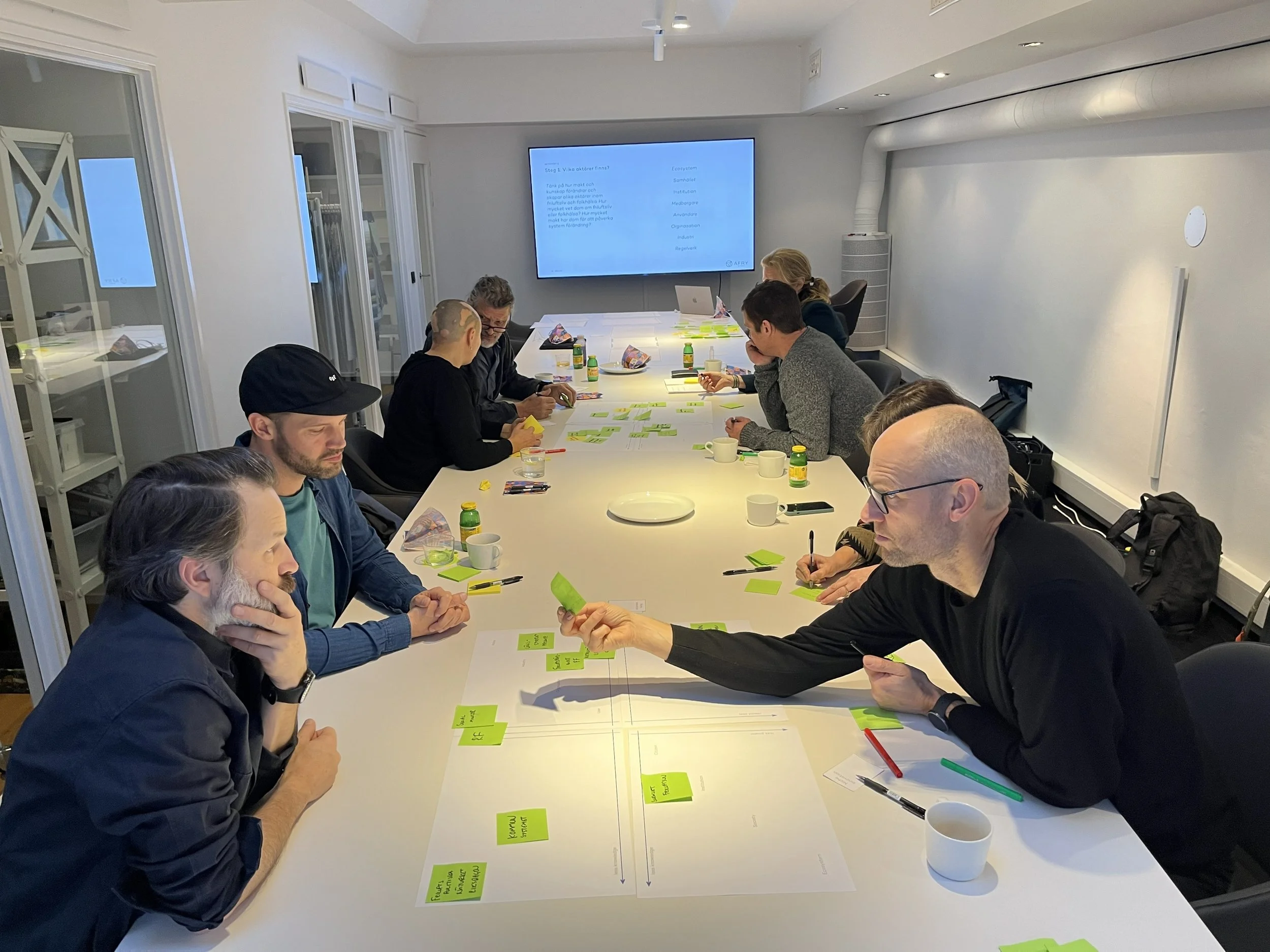
The project combined classical participatory design methodology with systems analysis techniques. While the team took a whole systems approach, there was a continuous focus on the everyday life of current Friluftsfrämjandet members, leaders, and non-member citizens.


00

knowledge transfer


workshop 1

Mapped the current system state with a mix of activities designed to highlight trends, identify system infrastructures, and innovators currently engaged in the topic.

02

workshop 2

Mapped the current system state with a mix of activities designed to highlight trends, identify system infrastructures, and innovators currently engaged in the topic.


03

packaging

Mapped the current system state with a mix of activities designed to highlight trends, identify system infrastructures, and innovators currently engaged in the topic.

Facilitation
Workshops
Knowledge transfer
Three Horizons
A short alignment activity inspired by Bill Sharpe’s Three Horizons Framework, so the workshops fit Friluftsfrämjandet’s organisational context. It also let the internal team align.
  • Current system concerns: What are the current challenges facing Friluftsfrämjandet?
  • Elements we need to sustain: What would you list as Friluftsfrämjandet’s strengths?
  • Vision: Describe what an ideal future would look like.
Workshop 1
Mapping the current system
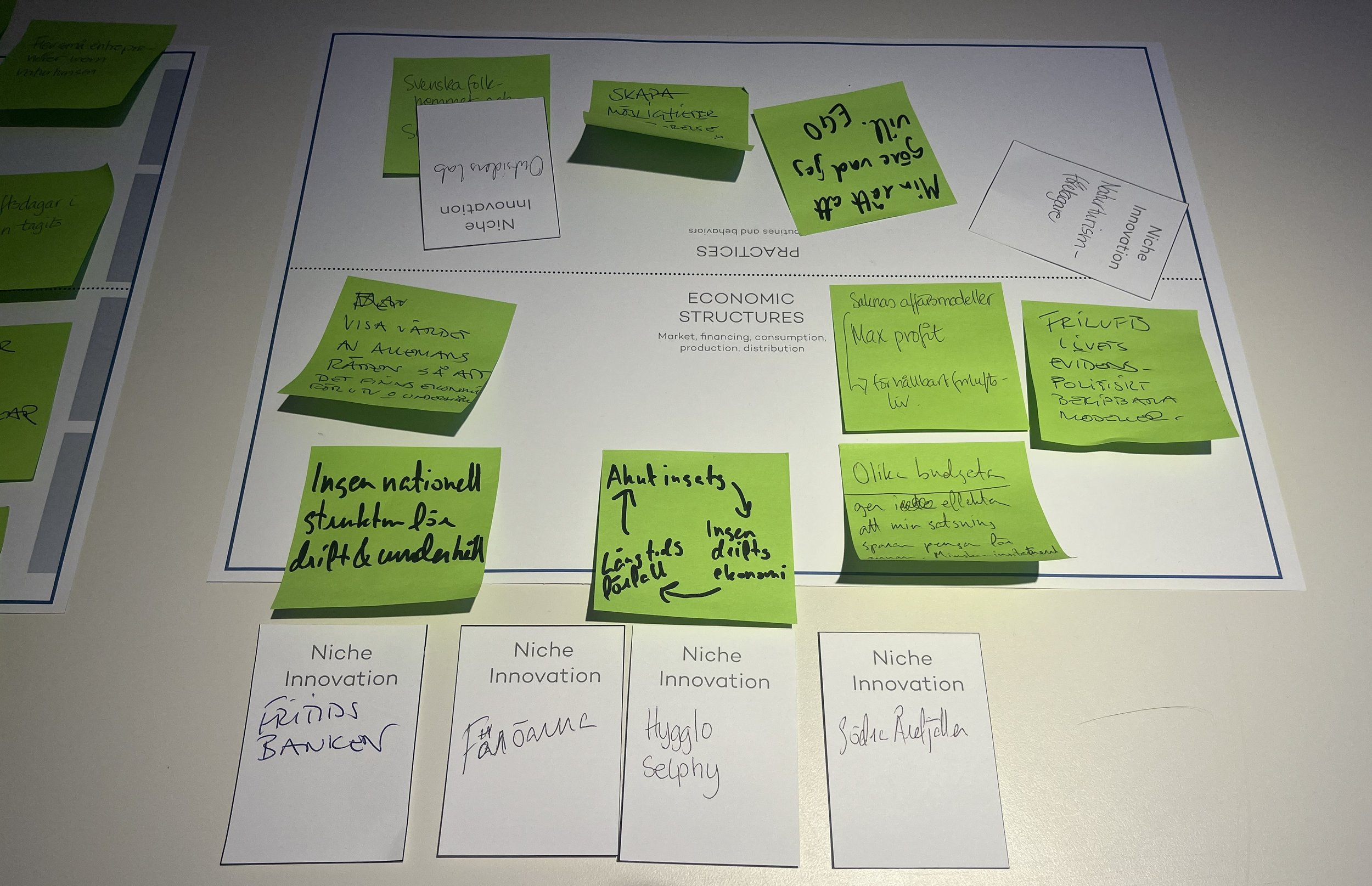
Participants worked from high-level trends down to niche innovators.
System mapping
  • Trends within outdoor lifestyle and public health
  • System structures within Economics, Culture, Practice and Institutional
  • Innovators working on each part of the system
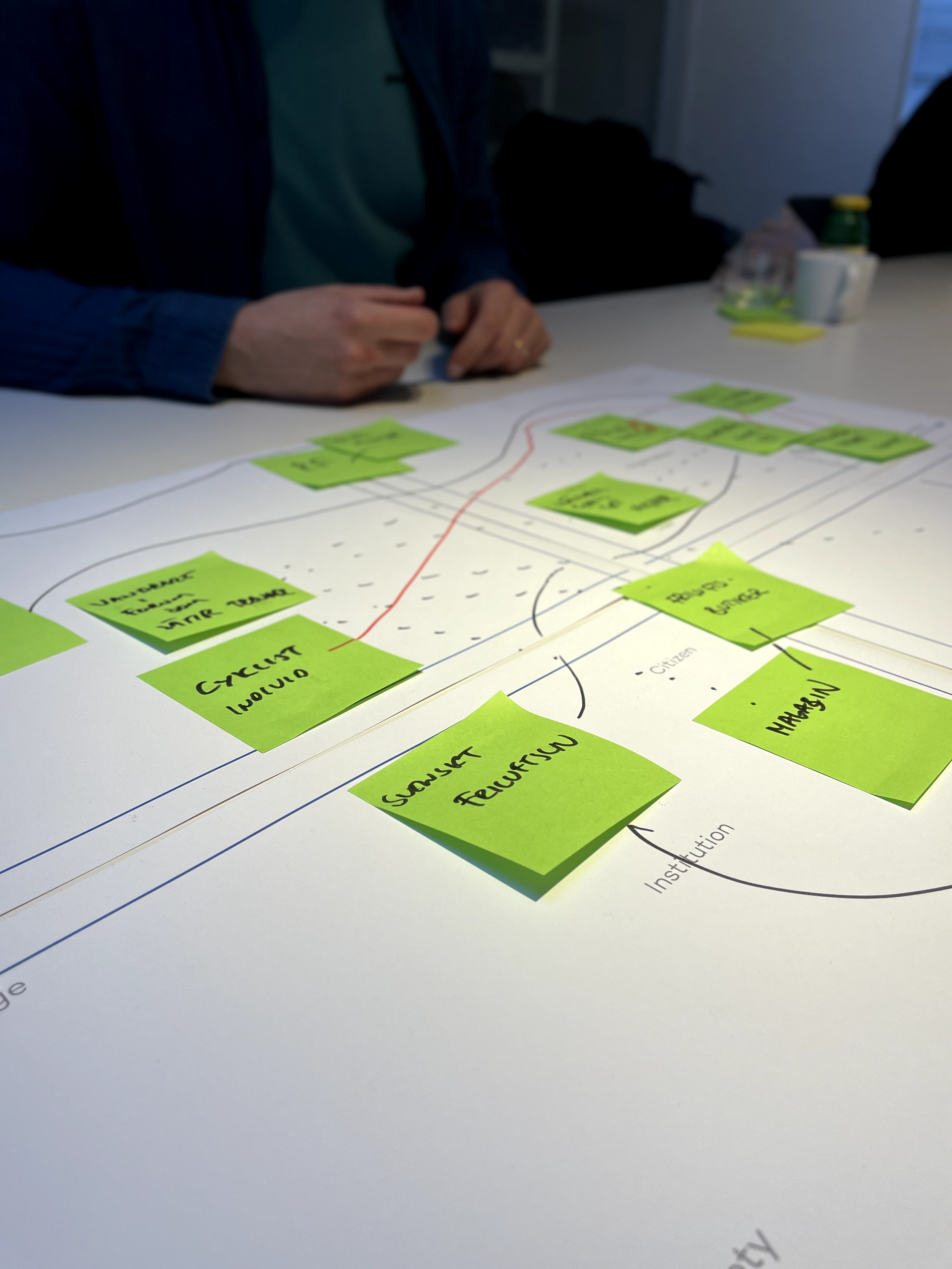
Actor mapping
  • Actors within the outdoor lifestyle and public health systems
  • Relationships between them: alliance, conflict, broken, svävande, or pretty close
Workshop 2
Leverage points and futures
Scenarios for 2027–30 and beyond, grounded in the mapping material.
  • What leverage points does Friluftsfrämjandet need to account for in its strategy?
  • What are possible futures for Friluftsfrämjandet?
  • What is Friluftsfrämjandet’s role in each scenario, and how do its existing relationships change?
  • What new relationships or partnerships would be needed in each pathway?
Actor map
Systems thinking
Workshop 1 placed the actors connected to outdoor activities and public health by their power to impact change and their knowledge of the domain, including their dependencies and power relations.
High power · low knowledge
Political and natural infrastructure
Political infrastructure on a national and local level, and natural infrastructure like reserves and the laws that govern their access. Power does not match knowledge within this group.
Allemansrätten, media, social minister, Skolstyrelsen, SJ, Länsstyrelsen, climate minister, Nacka nature reserve, forest owners, LRF, municipal politicians, primary care
High power · high knowledge
Knowledge-driven power
Public sector defined more by domain-specific knowledge, and larger non-profit organisations. Power and financing stem from their larger size and knowledge base.
Socialstyrelsen, financing institutes, STF, Friluftsfrämjandet, PKL, climate research, policymakers for protecting nature
Low power · low knowledge
Crowd-sourced impact
Actors connected to outdoor lifestyle and public health but with limited ability or knowledge to impact the domain. There is limited outdoor community connection within this group.
Schools, outdoor supplies companies, outsiders, magazines, Svensk Friluftsliv
Low power · high knowledge
Outdoor lifestyle as social glue
Groups of enthusiasts focused on a specific activity like biking or climbing. There is activity-specific knowledge, but their size restricts financing and power.
Members of Friluftsfrämjandet, Naturkartan, women’s network in Friluftsfrämjandet, nature tourism companies, Bergsidan, Naturvårdsverket
Insight
Conflicts stemmed from actors with low knowledge and high power.
There were few close relationships with low power, high knowledge actors, and few solid relationships between actors of high and low power to impact change. Making or strengthening situational connections is one pathway to systems change.
How access to nature is managed (Allemansrätten, landowners, nature reserves) involved actors with both knowledge and power, a dynamic that could prove problematic as financing shifts away from the state level.
Four futures
Leverage points and scenarios
Leverage point A
Political support for outdoor lifestyle and public health
High: a high level of national funding and a directive to strengthen the connection between the two. Low: no recognition of the value of outdoor lifestyle, and a drastic reduction of financial and political support.
Leverage point B
Social solidarity around sustainable transition
High: societal buy-in on the need to care for nature, and solidarity among organisations working towards it. Low: an individualistic view of the human-nature relationship, defined by denial of human impact on the climate crisis.
A+ · B+
Mission driven collaboration
Efficient and directed collaboration both internally and with external parties like the state, healthcare providers, or other non-profits. Cross-sector communication and understanding are vital.
Friluftsfrämjandet’s role
Securing a sustainable outdoor lifestyle. Identifying early actors with domain-specific knowledge; sharing knowledge across domains is a driver.
A+ · B−
Business led outdoors
Political support focuses on the private sector, away from non-profits. Access to nature is determined by who can pay; outdoor lifestyle is increasingly seen as a luxury.
Friluftsfrämjandet’s role
Put even more at odds with organisations seeking similar funding. Activism for universal rights to nature is needed even more.
A− · B+
Grassroots organization out of necessity
Little political support, so those with high knowledge and a surrounding community achieve their goals through crowd-sourced means.
Friluftsfrämjandet’s role
A supporting role: spreading knowledge and aiding community-centric groups, with higher demand on the volunteer structure.
A− · B−
Outdoors for the rich
After an external crisis, the relationship to nature is determined by who can pay. Political funding has dried up, landowners reduce access, and nature reserves are treated like amusement parks.
Friluftsfrämjandet’s role
Curated adventures become even more vital, along with educating public and private actors on the value of outdoor lifestyle.
Two focus areas
Key takeaways
Focus area 1
Future of Nature Access
Can Friluftsfrämjandet serve as a securer of sustainable outdoor lifestyle, and can its activities strengthen the value of near-city nature areas? Friluftsfrämjandet can be a catalyst in drawing together a co-owned impact model focused on the social value of a sustainable transition within and around urban spaces. It could also be a pathway to reach members of society it has traditionally had difficulty reaching.
Strategic partners
A city with ambitious climate transition targets with a social element (Stockholm), social impact financer, local schools, insurance company, or Länsstyrelser.
Co-benefits
Increased diversity of participants in outdoor activities, reduction in anxiety and depression, or cleaner nature areas.
Focus area 2
Definition of ‘friluftstimme’ value
Of the data presented during the project, ‘friluftstimmar’ (hours spent outdoors) showed the most promise in forming a correlation between activity and desired impact. Because of the need for dynamic baselining and the broad range of activities, a deeper dive into how to value them is needed. Defining the elements of a ‘friluftstimme’, and which can be tweaked by context, is key to establishing a tradeable value.
Strategic partners
A city or kommun with a progressive position on public health and climate targets (Helsingborg City or Blekinge Region), impact financer, local Friluftsfrämjandet organisations, or the nature tourism sector.
Co-benefits
Reduced unwilling loneliness, reduced sound pollution, cleaner nature areas, or increased local participation in activities.